Holloway Roberts
House of LeavesHolloway Roberts embodies the expedition’s most forceful version of confidence: a professional hunter and explorer who enters the Navidson house armed, physically imposing, and convinced that hostile territory can be mastered through discipline and firepower. His later recorded disintegration gives that confidence its tragic counterpoint, revealing that the house can reduce even an experienced guide to a man who is lost, starving, hunted, and unable to understand what awaits him.
Identity and Introduction
Holloway Roberts is introduced as a broad-shouldered, bearded man with a deeply creased brow and a powerful build. At forty-eight, dissatisfaction drives him to push himself harder than men half his age. Born in Menomonie, Wisconsin, he has made his career as a professional hunter and explorer, and his reputation rests on both leadership and courage. An account of his character emphasizes the security he inspires in life-threatening situations, even while acknowledging that his strength and relentless drive can irritate those around him.
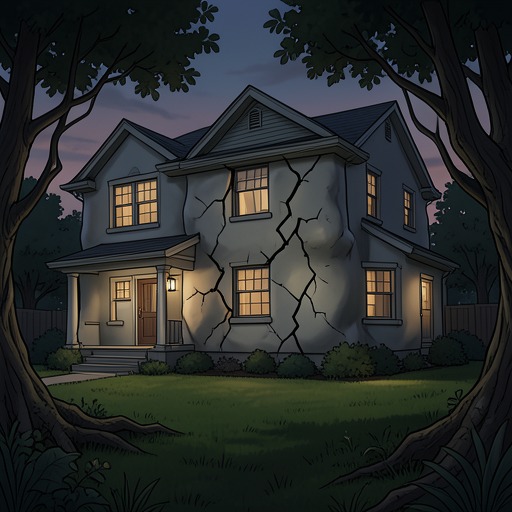
His first visible arrival at the Navidson house establishes this reputation through equipment and posture. He steps from a truck carrying a Weatherby .300 magnum, and the rifle is present in the very first shot that shows him. On the front lawn, with his arms folded and his eyes scrutinizing the house while bees move near his boots, he appears less like an ordinary guest than a conquistador preparing to claim unfamiliar territory. The image makes his exploratory identity inseparable from confrontation: the house is not merely a place to inspect but an environment he instinctively approaches as a potential battlefield.
Conduct Inside the House
Holloway responds to the house primarily as a hunter. When the expedition encounters evidence that the environment can expel objects and provisions, he does not pursue an abstract explanation. Kneeling beside his pack, he removes the Weatherby, checks the bolt and scope mounts, and loads five 180-grain Nosler Partition rounds before chambering a sixth. The careful preparation is practical, ritualized, and visibly gratifying; a glimmer of joy crosses his face as though the weapon has restored a recognizable logic to an otherwise impossible place.
That discovery prompts Holloway to insist on exploring at least some of the immediate hallways branching from the staircase. He stalks doorways, directs the barrel of his rifle along the moving beam of Jed Leeder’s flashlight, and listens for danger. Yet the architecture refuses the familiar progression of a hunt. Corners disclose more corners, the flashlight finds only ashen walls, and the distant growl suggests an expanse in which rooms and passageways seem to become a horizon rather than lead toward a conventional destination. His method remains consistent, but the space continually defeats the assumptions behind it.
The Holloway Tape
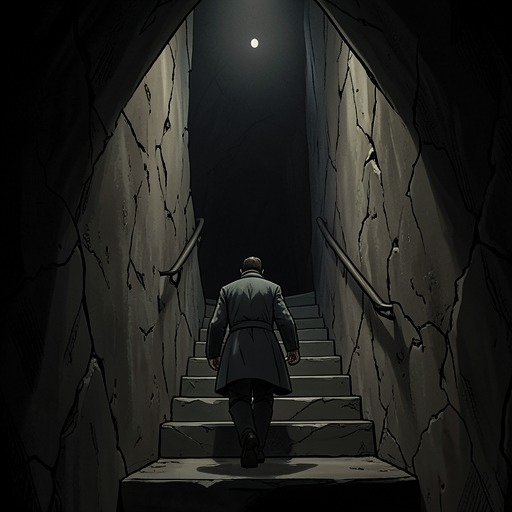
The Holloway Tape presents a radically different Holloway from the armed figure who first enters the house. It begins with him staring into the camera against a backdrop of wall, and the footage traces the final moments of his life in fragments that are coherent chiefly as a decline. He reports that he is lost, out of food, low on water, and without any sense of direction. The statements reduce the accomplished explorer to the basic conditions of survival, while the repeated attempt to identify himself supplies a fragile counterweight to the disappearance of place and orientation.
Holloway says that something is present with him and corrects himself from being followed to being stalked. He explains that the presence has pursued him for days without attacking, apparently waiting for something he cannot identify. He then gives his name, birthplace, and educational background, stating that he is not alone. These details function simultaneously as testimony and self-preservation: biography becomes a way to insist on a stable identity while the house strips away every reliable landmark.
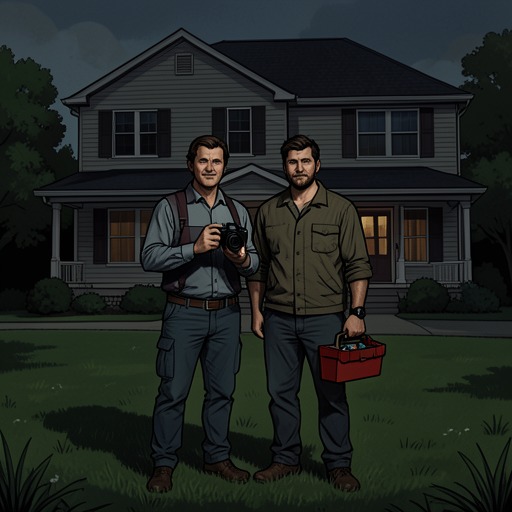
The tape also complicates the distinction between Holloway’s behavior and Will Navidson’s. Although the hunter and the Pulitzer-winning photojournalist respond to the house in sharply different ways, the recovered footage suggests that either man could ultimately be consumed by the same environment. Holloway’s expertise may alter his route through the space, but it does not guarantee escape from the house’s larger pattern of disorientation and threat.
Relationships and Narrative Function
Holloway’s conduct places him in a practical but tense relation to the other explorers. He leads the movement into the branching hallways, while Jed Leeder’s flashlight supplies the visibility by which Holloway aims and advances. The arrangement reveals both Holloway’s authority and the limits of that authority: he can take the forward position and point a weapon into darkness, but he cannot make the corridors behave like territory that a hunter can read.
Within the larger account, Holloway serves as a test of competence. His strength, experience, courage, and carefully maintained weapon suggest that preparation might protect a person from the unknown. The Holloway Tape overturns that expectation without simply mocking him. His failure is powerful precisely because the evidence first establishes him as someone others trust in dangerous situations. The more convincing his competence appears outside the labyrinth, the more disturbing his recorded helplessness becomes inside it.
Change and Significance
Holloway’s trajectory moves from controlled aggression to radical uncertainty. At the house, he greets the unknown with a rifle, advances through doorways, and treats the growl as a sign that the environment may finally be yielding a readable threat. In the tape, however, he has no food, little water, no direction, and no clear account of the thing stalking him. The hunter’s language of pursuit survives, but its logic has been reversed: he is no longer the one tracking an objective; he has become the tracked object.
His repeated naming of himself, Menomonie, Wisconsin, and his education gives the tape a final structural irony. The details that once authenticated him as a professional and individual cannot restore his location or secure his survival. Holloway remains legible as a person at the very moment the house makes his situation incomprehensible. His apparent end therefore becomes one of the clearest demonstrations that the Navidson house does not merely frighten its explorers; it dismantles the systems of knowledge, orientation, and mastery on which their identities depend.